The pile is the tariff.
July flooded the US with copper. Comex stocks sit near records. The refined copper tariff that would justify the pile still isn’t written — the White House stalled on 10 Sep.
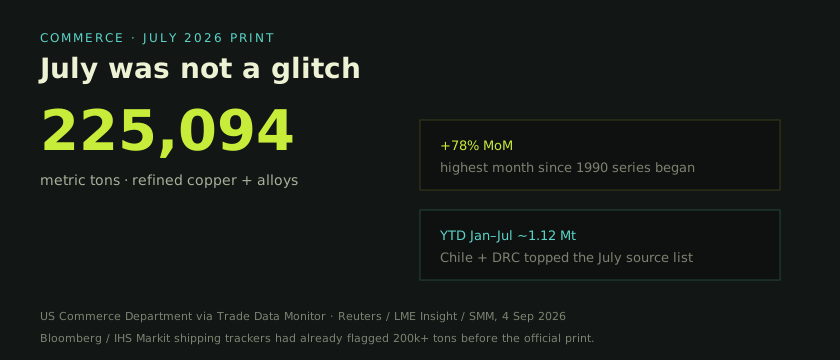
July put a flood of copper into the United States — 225,094 metric tons of refined metal and alloys, the highest month in Commerce records back to 1990. Comex warehouses now hold on the order of 697,000 tonnes, most of the world’s exchange-tracked copper. The refined copper tariff that would make that pile rational still isn’t written. On 10 Sep the White House stalled. The inventory is a bet on a law.
Open on the pile
US Commerce Department trade data put 225,094 mt of refined copper and copper alloys into the country in July — up 78% month-on-month and 8% year-on-year.LME Insight / Commerce Shipping trackers had already flagged more than 200,000 tons before the official print landed.Bloomberg / IHS Markit
Chile and the Democratic Republic of Congo topped the July source list. Year-to-date through July: about 1.12 million tonnes. That is not residual demand catching up. That is front-loading a copper tariff that hadn’t been signed.
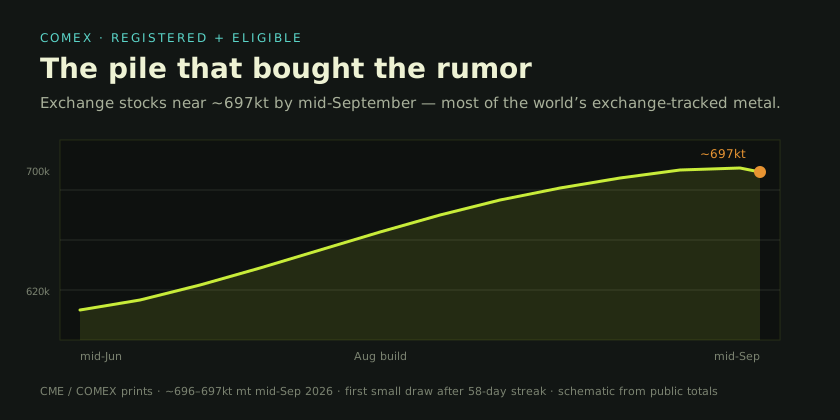
By mid-September, Comex-approved vaults held roughly 696–697kt — about 767,000 short tons registered plus eligible — after a 58-day daily build streak finally broke with a small draw.ConnectOre / CME Roughly 69% of exchange-monitored copper was sitting in US warrants. New Orleans still took the biggest share of that stack.
What exists vs what doesn’t
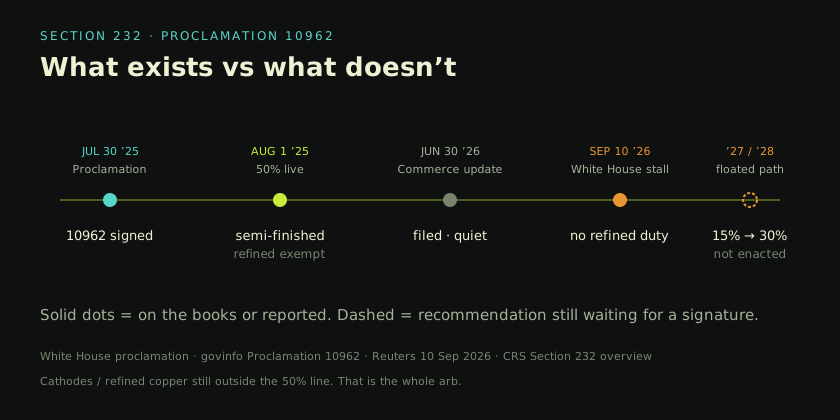
What exists on paper: Proclamation 10962 — the White House’s 30 July 2025 copper proclamation under Section 232. It slapped a 50% tariff on semi-finished copper products and intensive copper derivatives from 1 August 2025. Refined copper — cathodes, the stuff that fills Comex warrants — was carved out.White House proclamation
What was supposed to follow: by 30 June 2026, Commerce updates the President on domestic copper markets so he can decide whether to impose a phased universal duty on refined copper — 15% from 1 January 2027, rising to 30% from 1 January 2028. That schedule was a recommendation in the June 2025 Section 232 report. It was never a signed duty.
The stall
Commerce delivered the update by the deadline. As of mid-September, the White House still has not announced a decision. Reuters reported on 10 Sep that officials were juggling affordability politics against the pitch for more domestic mining and refining ahead of the midterms — Commerce Secretary Howard Lutnick’s recommendation stayed quiet.Reuters, 10 Sep 2026
A White House official told Reuters the administration “continues to evaluate all options.” That is not a tariff. That is optionality dressed as industrial policy — and the market had already run a year-long arb on a paragraph that says “may determine whether.”
Who holds the bag
Not the government. Traders.
The Comex–LME spread paid the freight. Metal left Asia and Europe for US delivery because the US quote cleared the arb after costs. Ex-US exchange stocks thinned while the American pile grew. That is geography as policy — without a duty line in the HTSUS for refined copper.
Fastmarkets put the blunt version: a de facto strategic stockpile built by private desks. Washington spent nothing. It floated a possible tariff, traders did the math, and the metal arrived.Fastmarkets
The premium that financed the carry has compressed. Mid-September prints put the Comex spot premium over LME around 1.6¢/lb — the narrowest since spring — after the spread had been hundreds of dollars a tonne wider in late August.IndexBox / market prints Contango paid the warehouse. Whether US industry is now absorbing the metal, or the front-run is unwinding, is the live question. A first small Comex draw after months of builds is a hint, not a verdict.
Global squeeze
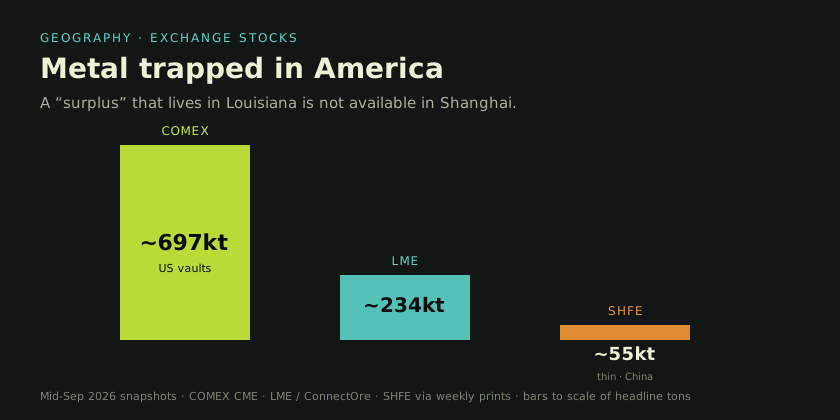
Metal trapped in the US is not metal available in London or Shanghai. LME headline stocks sat near 234kt in mid-September prints; Shanghai futures stocks had fallen into the mid-50kt range — thin by recent standards.ConnectOre
Surplus assumptions that ignore “stranded in America” fail the map. Re-export is often uneconomic once metal is inside US warehouses and tariff risk stays alive — the pile can sit as a hedge long after the arb that built it is gone.ING
What to open
-
Is the duty law or a recommendation
15% / 30% on refined is still a recommendation unless a proclamation or HTSUS line says otherwise. Semi-finished at 50% already is.
-
Who is long the warrants
Exchange stock is not a national reserve. It is trader inventory with a carry cost and a thesis.
-
Comex vs LME location
A global “surplus” that lives in Louisiana is not available in Shanghai. Price the geography, not the headline tonnage.
-
What kills the arb
A clear no, a long delay with affordability language, or a duty so soft the spread collapses. Ambiguity keeps paying rent.
-
Manufacturer pass-through
If the refined duty ever lands, who eats the cost — fabricators, OEMs, or end buyers. Semi-finished already shows the shape.
July’s 225,094 tons cleared customs on a bet. The copper tariff that would settle that bet is not on the books. Until it is, the pile is the tariff — and the invoice is the metal sitting in the dark, accruing storage, waiting for a signature that may never come.